

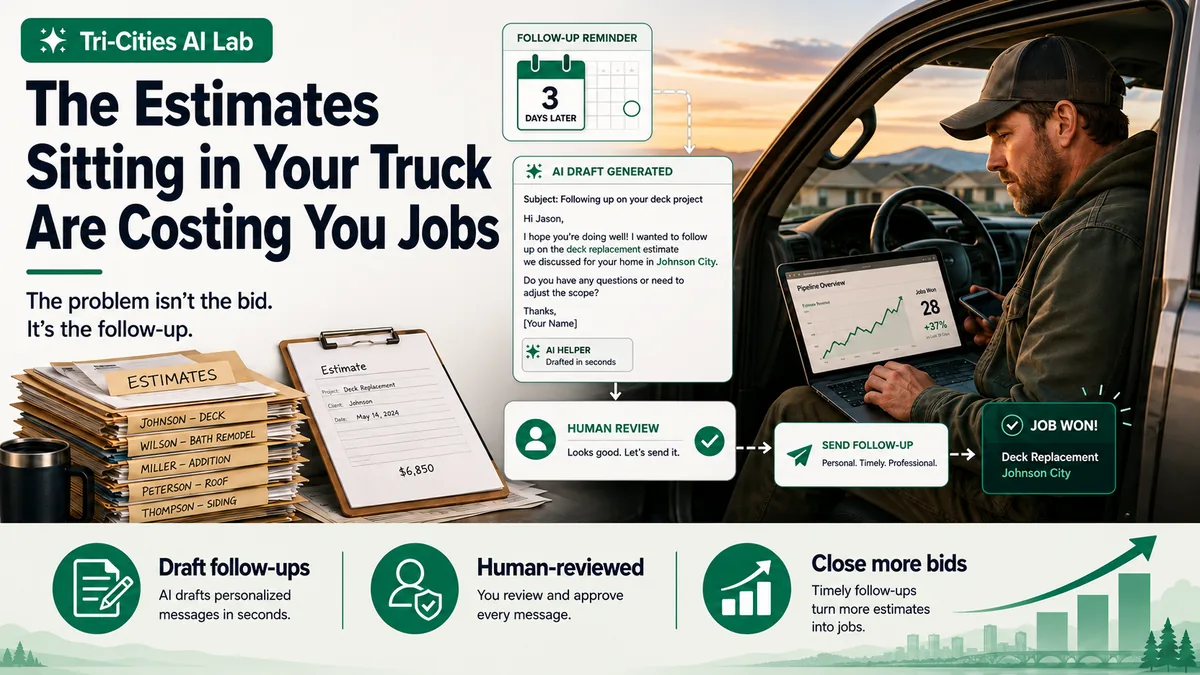
Every contractor in the Tri-Cities knows the feeling. You walk a job, write up the estimate, hand it over or email it, and then… nothing. Two weeks go by. You’re already onto the next site, the next bid, the next emergency callback. The estimate sits in someone's inbox. Or it doesn't, they hired the other guy because he called them back on Thursday.
The math is brutal. If you write 8 estimates a week and close 3, that’s 5 jobs walking out the door, and many of them weren't lost on price. They were lost on silence.
The real problem isn’t the bid. It’s the follow-up.
Follow-up is the kind of work that’s important but never urgent. It’s exactly the kind of work that falls off the truck when you’re running a small crew, doing your own books, and trying to be home for dinner.
This is where a small, human-reviewed AI workflow can save time and reduce repetitive work without changing how you actually do estimates.
What this could look like in your business
Here’s a practical setup, not a theoretical one:
- You finish an estimate in whatever you already use: Jobber, Housecall Pro, JobTread, QuickBooks, a Google Doc, a paper carbon copy you photograph. Doesn’t matter.
- A quiet workflow runs in the background. It pulls the customer name, job type, total, and date sent.
- Three days later, it drafts a short follow-up email, written in your voice, referencing the actual job (“the back deck rebuild at the Mitchell place in Colonial Heights”), not some generic “just checking in!” template.
- The draft lands in your inbox for review, not the customer’s. You read it, tweak a line if you want, hit send.
- A week later, if there’s still no answer, it drafts a second one. Friendlier, shorter. Same review-before-send rule.
That’s the whole thing. No chatbot answering for you. No “assistant” pretending to be you. Just a quiet helper that drafts the message so all you have to do is read and approve, not write from scratch at 9pm.
Why “human-reviewed” matters here
In a small trade business, your reputation is everything. The wrong tone in a follow-up (too pushy, too generic, too obviously written by a robot) can cost you the job and damage your name. You stay in the driver’s seat on every message that goes out. The AI does the typing. You do the judging.
That’s the difference between an AI that helps you and an AI that embarrasses you in front of customers.
What it actually gets you back
Drafting follow-ups by hand takes most contractors 5–10 minutes per email once you’ve found the job notes, remembered the customer’s name, and warmed up enough to not sound like a stranger. Across 8 estimates a week, that’s roughly an hour. Across a year, that’s about 50 hours of your time (a full work week) recovered. Plus the bigger upside: you actually close more of the jobs you already bid.
Where this fits
This isn’t software you buy off a shelf. It’s a small, private and practical workflow built around how you already run estimates: the tools you use now, the language you actually talk in, the timing that works for your trade. It can run on your own files and your own email account, without shipping customer data off to a dozen third parties.
That’s the kind of thing we build at Tri-Cities AI Lab for contractors across the Tri-Cities.
Curious what this would look like for your business? Drop us a line at hello@tricitiesailab.com. First conversation is always free, and if AI isn’t the right fit for what you’re trying to solve, we’ll tell you straight.